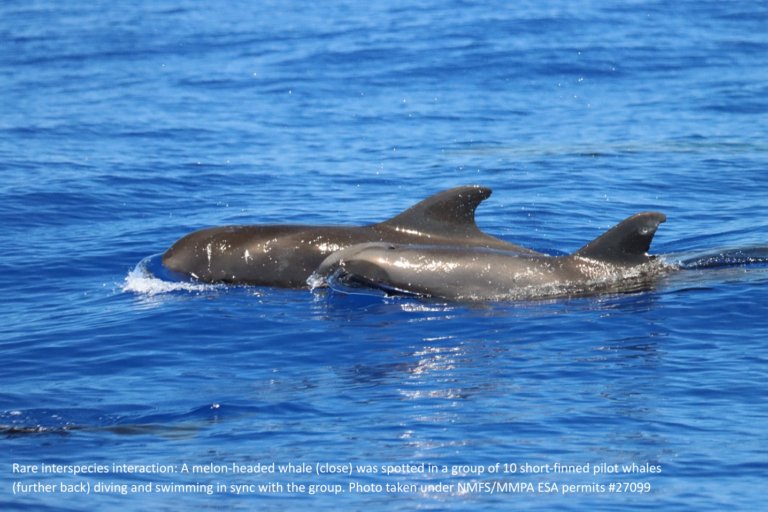
While carrying out surveys in the offshore waters of Lānaʻi, the Pacific Whale Foundation (PWF) research team anxiously waited for a marine mammal sighting, and what they found was unexpected! The ocean may be vast, but two different species defied norms and were spotted in a rare interspecies interaction.
One melon-headed whale was seen within a group of short-finned pilot whales and exhibited different behaviors compared to previous encounters between these species. Unlike past interactions, this individual was alone and matched the short-finned pilot whales’ behaviors.
In previous encounters, groups of melon-headed whales were observed encircling the short-finned pilot whales and increasing their vocalizations, appearing to antagonize them (see video below); however, this individual seemed to fit right in with the short-finned pilot whale group by matching their swimming speed and diving behaviors.
What are interspecies interactions?
Throughout any ecosystem, organisms interact with each other and the natural world around them. These interactions can be short or long lived and are no stranger to the cetacean world. PWF researchers have observed this with various species; for example, in Maui Nui a single bottlenose dolphin is almost exclusively sighted with groups of humpback whales. Cetaceans like whales, dolphins and porpoises, can form interspecies relationships for many reasons which may include predator deterrence, socialization, cooperative hunting, or predator avoidance. However, it is difficult to determine the exact reason certain individuals interact with other species.
Short-finned pilot whale vs Melon-headed whale
Throughout Pacific Whale Foundation’s 45 years of research, short-finned pilot whales have been documented within these interspecies interactions only a handful of times. The most common interactions occurred with spotted dolphins (4 encounters), melon-headed whales (3 encounters prior to 2026) and false killer whales (1 encounter).
The difference between those past three encounters between short-finned pilot whales and melon-headed whales is that previous interactions included multiple individuals from each species. The single melon-headed whale spotted in April was in a group of 10 short-finned pilot whales!
So how can you tell the difference between these two blackfish?
Short-finned pilot whales:
- Size: 12-24 feet; 2,200-6,600 pounds
- Dorsal Fin: length of the dorsal fin base is twice the height, located forward of the center of the body
- Head: round and flat (becomes flatter as they age)
- Habitat: 500-3,000 m
- Coloration: black to dark grey brown body with lighter grey saddle located behind the dorsal fin
Melon-headed whales:
- Size: 3-9 feet; 460-600 pounds
- Dorsal Fin: large dorsal fin relative to their body size, located centrally on their back
- Head: slightly pointed (may flatten as they age), lighter/white-colored lips
- Habitat: 300-1,000+ m
- Coloration: dark grey to black with contrast to darker dorsal cape
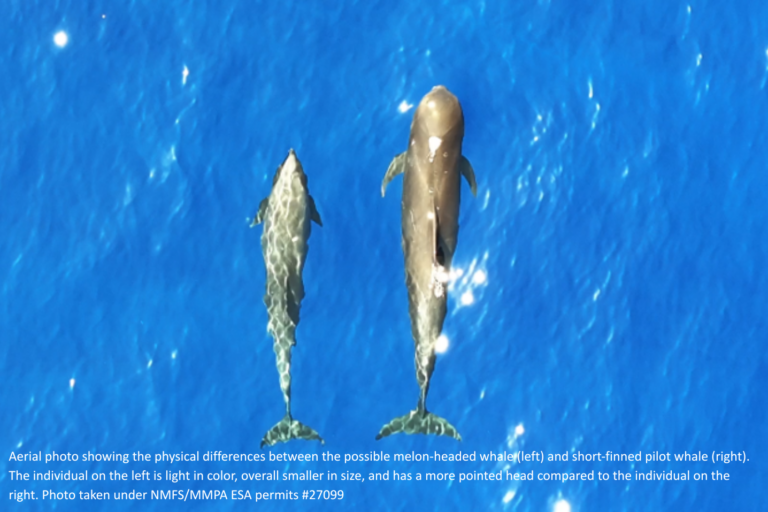
After reviewing camera and drone footage, our research team determined that the presumed melon-headed whale had multiple physical characteristics that differed from its companions. Following discussions with colleagues at Cascadia Research Collective, the consensus was that the animal had many features of a melon-headed whale but differed in the pigment on the dorsal cape as well as the head shape (more pointed for its age). However, it is hard to say for certain without a biopsy sample and genetic testing as it could also be a hybrid, which has been documented before, between a melon-headed whale and rough-toothed dolphin.
Behaviors observed during encounters
Another interesting note was its behavior, which was unlike past findings. Two of the past interspecific encounters showed the melon-headed whales antagonizing the short-finned pilot whales. Behaviors such as lunging, encircling, body checking, and attempted biting were displayed by the melon-headed whales while the short-finned pilot whales showed spyhopping, fast changes in direction, and rolling in response. However, the most recent sighting did not include any of these antagonizing behaviors, and it appeared harmonious.
In 2002, PWF published a paper on short-finned pilot whales with melon-headed whales. This paper found increased vocalizations and again encircling behaviors by the melon-headed whales, and spyhopping exhibited by the short-finned pilot whales. Enhanced foraging success was ruled out due to a lack of deep diving and other feeding behaviors by either group. The conclusion was that the two species either came together by chance, and it was a curious interaction, or that it was to increase protection from possible predators.
This clip from an encounter on October 4, 2024, shows possible antagonizing behavior on behalf of the melon-headed whales towards two short-finned pilot whales. These behaviors include lunging, body checking, and attempted biting. The UAS pilot holds FAA Part 107 authorization. Taken under NMFS/MMPA ESA permits #27099.
Past research observations have deduced that short-finned pilot whales play offense by antagonizing larger marine mammals such as humpbacks and fin whales, yet smaller species put them in a defensive position against said behaviors.
Why is this important?
We may never fully understand why these two species came together in the past, and why only one melon-headed whale chose to spend time in a group of short-finned pilot whales. Typically, melon-headed whales are social cetaceans, forming large groups, so it was extra peculiar when we only spotted one individual within a pod of a different species.
This mystery remains unsolved for now, yet it shows the importance of long-term monitoring efforts carried out by PWF.