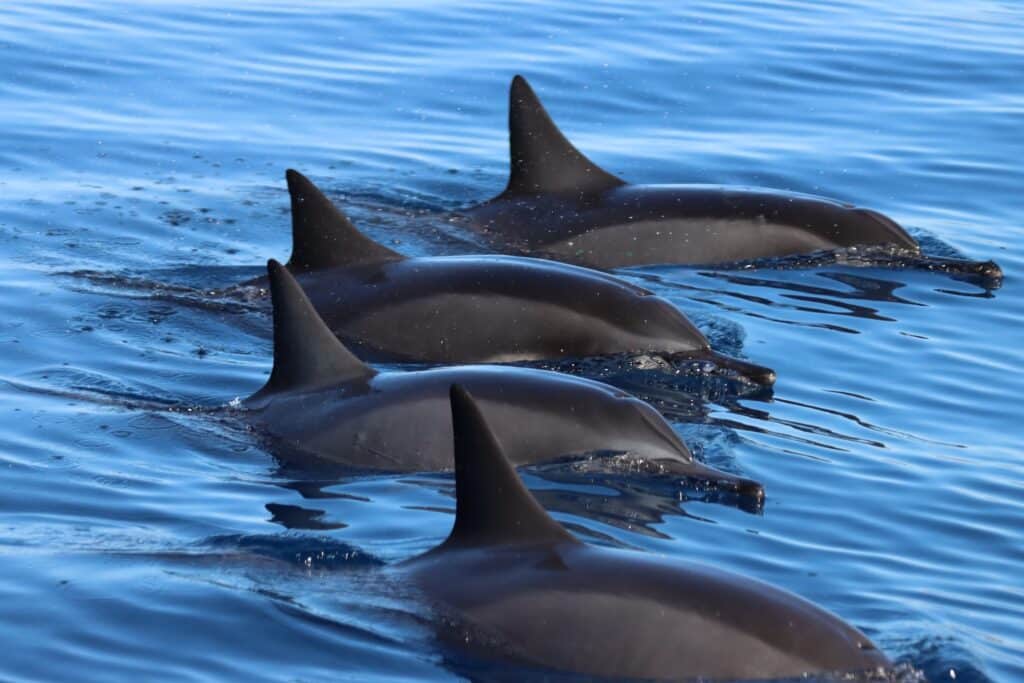
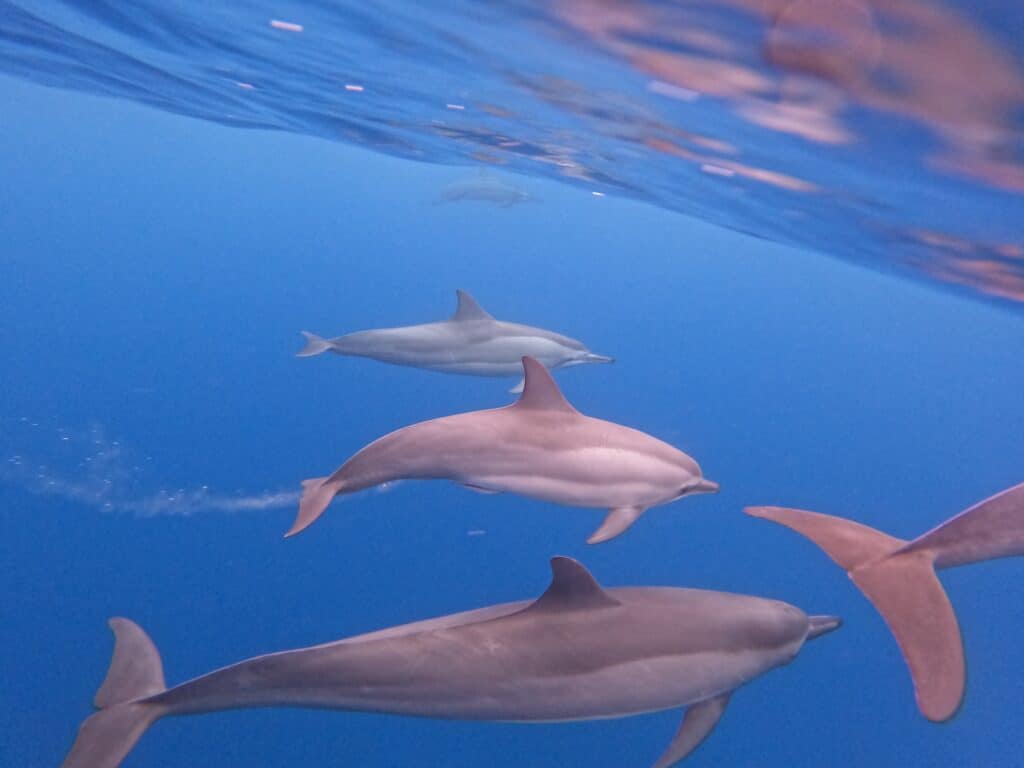
In a changing marine environment with increasing human threats, it is important for scientists and those working in conservation management to consider the larger level connections that keep ecosystems functioning. To address this, we wanted to better understand how spinner dolphins might contribute to the functioning of marine ecosystems around Maui Nui. Marine mammals have been shown to support ecosystem function through the redistribution of nutrients, although most research has focused on large whales, often referred to as the “whale pump”.
When large whales forage in deep water and release fecal plumes and urinate at the surface, they can supply new nutrients which increase productivity in ecosystems. Our recent work explored the nutrient transfer role, or what we call the “dolphin tap” of spinner dolphins in Hawai‘i.
Why spinner dolphins?
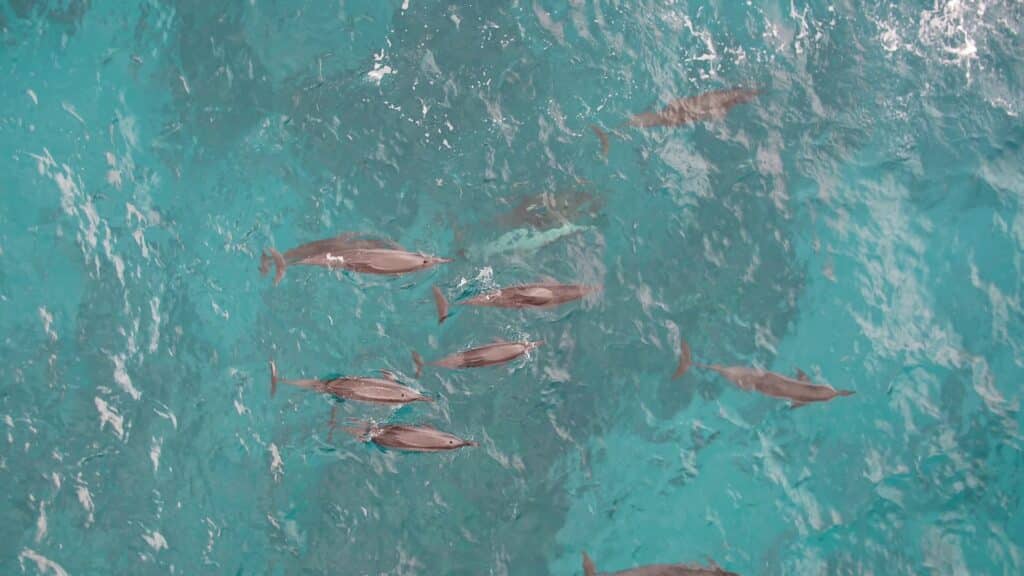
Spinner dolphins in Main Hawaiian Islands (MHI) waters rest and avoid predators inshore during the day and feed offshore at night. In the Maui Nui region, the overall shallow channels separating the four islands and the protection from wind provide habitat for spinner dolphins to rest and travel throughout the day. The protection of the islands also provides an ideal location for coral reefs ecosystems. Based on their known patterns, we believed that spinners dolphins could play a role in ecosystem functioning by transferring nutrients from offshore where they feed to inshore habitats, including coral reefs, which we called “the dolphin tap”. Our long-term research on spinner dolphins in this area provided the opportunity for us study where the dolphins are spending their time during the day and estimate how much nutrients they could transport, specifically to coral reef habitats. This connection is important to understand since both spinner dolphins and coral reefs are highly susceptible to disturbances from humans.
What did we find?
We estimated that an individual spinner dolphin would transport 0.10 kilograms of nitrogen a day (SD = 0.02) into the overall marine environment. This is enough to fertilize roughly 1,000 young apple trees in their first year of growth—naturally supporting the health and resilience of Hawaiʻi’s coral reefs. We found that spinner dolphins overlapped with coral reef habitat for 28% (SD = 36%) of total sighting time. Using daytime-only observations, we estimated an individual spinner dolphin could supply approximately 300–500 kg of nitrogen each year from offshore feeding grounds to coral reefs. Individual-level annual deposition values were extended to group (mean = 65.40 individuals, SD = 45.24) and population (594 individuals) levels to determine nutrient supply in the overall marine environment and to coral reef habitats.
Why does the “dolphin tap” matter?
Previous research on birds, fish, and sharks found that the nutrients in animal waste (e.g., ammonium) can enhance coral reef growth and health. Several studies have shown that natural nutrients from animals can even decrease coral bleaching and promote recovery after bleaching events. Therefore, the naturally occurring nutrient input from spinner dolphins may enhance productivity and promote coral reef resilience and health. This relationship suggests that changes to spinner dolphin populations or their habitat use could impact coral reefs through a lack of beneficial natural nutrient sources. As Maui Nui’s coral reefs experience stress from warming oceans, the supply of nutrients from spinner dolphins may become increasingly important for sustaining coral reef function. Protecting spinner dolphins is therefore important for maintaining “the dolphin tap” nutrient pathway and supporting the health of Hawai‘i’s coral reef ecosystems. This science strengthens the case for spinner dolphin protections and ecosystem-based management of Hawaiʻi’s inshore waters